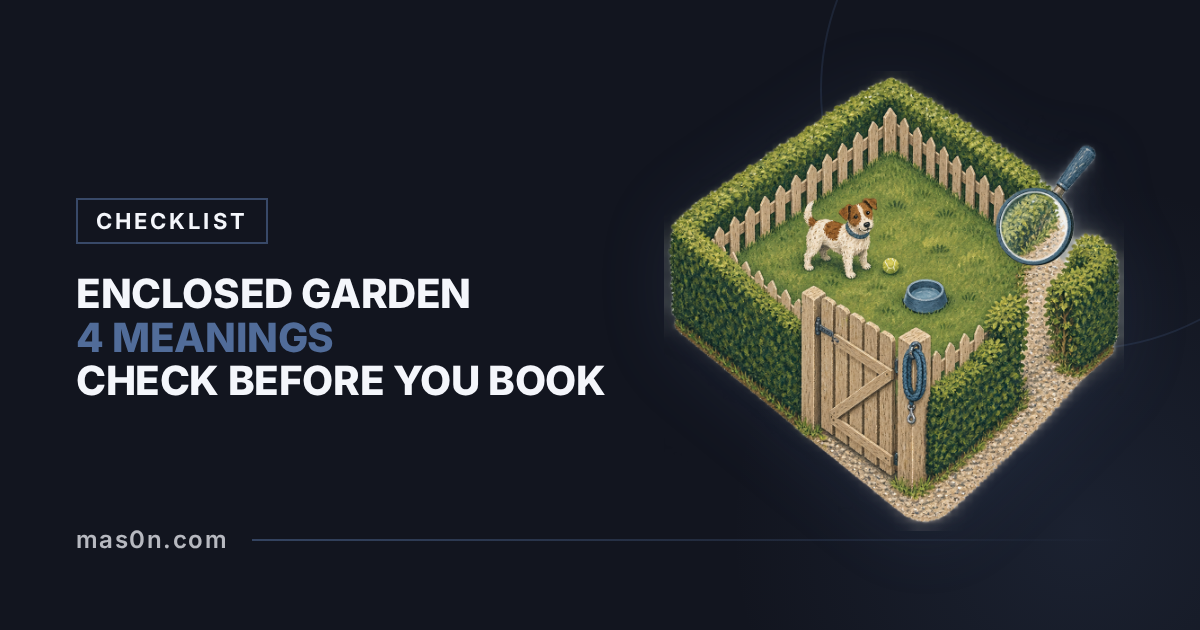
“Enclosed garden”is not a standard. It is a phrase, and on most booking sites it is the owner’s phrase, republished without anyone walking the boundary. That is the whole problem with searching for a dog friendly cottage enclosed garden: the filter tick box looks like a guarantee and behaves like an adjective.
I have shortlisted a lot of cottages for a dog who treats a 1.2m wall as a suggestion. The gap between what the listing says and what you find on arrival is almost always in the same four places: the gate, the lane side, the ground-level gaps, and whoever else drives through the yard. Here is how to check all four before you pay a deposit.
Why “enclosed garden”means four different things
No booking platform, tourist board or trade body publishes a definition. There is no minimum height, no maximum gap, no gate standard. VisitEngland grades the building, not the fencing. So two listings can use identical wording and mean completely different things: one is a 1.8m close-boarded fence with a sprung, self-closing gate, the other is a field edge with a thorn hedge and a two-foot gap where the barn meets the wall.
In practice, owners mean one of four things.
- Fully secure and dog-proof. Continuous boundary, no ground gaps, a gate that latches and only opens into the garden. Rare, and the owners who have it say so without being asked.
- Enclosed but imperfect. Solid on three sides, waist-high wall on the lane side, or a gate with a thumb latch at dog-nose height.
- Shared or communal. A courtyard or lawn used by the next cottage, the owner, and the oil delivery.
- Bordered. A wall, hedge, beck or stream marks where the garden ends. Nothing stops anything crossing it.
Some agencies do grade gardens into their own categories and will tell you the criteria if you ask. Most pass the owner’s description straight through unchecked. Assume the second until you have evidence of the first.
Then there is the photo crop. Listing galleries are shot to sell the view. You will get the fell in the background and the hot tub in the foreground, and almost never the gate, the driveway edge or the side return between the house and the outbuilding. The missing photo is usually the answer.
The checks that decide whether the garden is really secure
Height, measured against your actual dog. UK planning rules are a reasonable guide to what is typical: in England you generally need planning permission for a fence or wall over 2m, or over 1m where it adjoins a highway used by vehicles, according to the Planning Portal (check current guidance, as permitted development rules do change). That is why so many cottages are 1.8m at the back and waist height at the front. A springer on a rabbit scent does not read 1.2m as a barrier. Nor does a collie. Nor, embarrassingly, does a fat labrador with a running start.
Gaps beat height for most escapes. This is the part people underestimate. Standard stock netting is specified by things like 8/80/15, meaning eight horizontal wires, 80cm high, with verticals every 15cm. From ten metres away it photographs as a solid grey line. A terrier, a dachshund or a small lurcher goes through it without slowing down. Post-and-rail is worse: the gap under the bottom rail is often 20cm or more. Estate railings on converted farm plots are the same story.
Gates. Ask which way it swings, whether it self-closes, and what sits on the other side. A gate that opens outward onto a single-track lane gives you no airlock at all. A thumb latch is a puzzle most collies solve by week two. A gate with a 10cm gap under it is a gate for small dogs to use.
Dry stone walls, ha-has, becks and ditches. All four look impregnable in photographs. Dry stone walls are stepped, they drop at corners and gateways, and through-stones give a fit dog a foothold halfway up. A ha-ha is designed to be invisible from the house, which means it is also invisible to you on the gallery. Water is not a boundary for a spaniel.
Shared access. If other guests, the owner’s tractor or a van crosses the garden, it is not enclosed in any useful sense. One propped gate on a changeover Friday and the space is open.
How to verify it before you pay the deposit
Ten minutes of work, in this order.
Work the gallery properly. Look past the subject of each photo. Boundaries show up in the background of interior shots through the windows, and the parking photo usually reveals more about the perimeter than the garden photo does. Count the sides you can actually see. Be honest with yourself about the gaps.
Then go to satellite view. This is the single most useful free check and almost nobody does it. Find the postcode or the nearest named farm, zoom in, and trace the whole plot from above. You will see the real shape of the garden, where the drive meets the lane, whether the “private”lawn is actually the shared turning area for three cottages, and which side the gallery carefully avoided. Street View then tells you what the lane looks like and how fast traffic will be moving.
Ask two questions, not a general one. “Is the garden enclosed?”gets you “yes”every time. These do not:
- “Can my dog be off the lead in the garden with nobody watching?”
- “Is any part of the boundary under 1.2m, or open to the lane or the track?”
Owners with a genuinely secure plot answer the first one yes, immediately, and often volunteer the fence height. A hedged answer is the honest signal and you should treat it as a no. Ask for a photo of the gate, or a ten-second video walking the perimeter. That request separates the two groups faster than anything else.
Get the reply by email rather than phone. If the garden on arrival does not match what you were told, a written answer is what you need. I have gone further into the wording and the follow-ups in this piece on the questions to ask before booking a dog friendly cottage with an enclosed garden.
Cumbria and the Lake District: walls, grids and sheep
In fell country the boundary question is a livestock question. Dog friendly cottages in Cumbria are frequently converted barns and farmhouses sitting inside working land, and the field over the wall has sheep in it for most of the year.
A cattle grid at the end of the drive keeps stock in. A dog trots straight across it. I have watched a spaniel do exactly that while the owner was still explaining that the grid “keeps everything in”.
The legal exposure is real. Under the Dogs (Protection of Livestock) Act 1953 it is an offence to allow a dog to worry livestock on agricultural land, and the person in charge of the dog can be prosecuted. Separately, the Animals Act 1971 gives a farmer a defence for shooting a dog worrying livestock in certain circumstances. That is the context you are booking into. An unreliable wall is not just an inconvenience.
Two more Lake District patterns worth knowing. Hill farm conversions often share the courtyard with the farm’s working yard, so the flagged area in the photo is a thoroughfare at 7am. And lakeside or beck-side cottages regularly describe water as the boundary on one side, which is fine for sheep and useless for a dog.
A typical trap: the gallery shows a flagged courtyard with a smart timber gate. Satellite view shows the courtyard is the turning space for three cottages plus the farm’s vehicles, and the gate opens onto a single-track lane with a cattle grid 30 metres down it. Every word in the listing was true.
Arriving without a car changes the threshold
If you are coming by train and bus, the garden stops being a convenience and becomes infrastructure. There is no boot to shut a soaking dog into, no crate in the back, and no vehicle for the last mile to a walk. The enclosed space is your drying area, your 11pm toilet stop and the only off-lead ground you control all week.
Penrith and Oxenholme are the usable arrival points on the West Coast Main Line. From Penrith you can pick up buses towards Keswick or Ullswater; dogs are generally carried on Stagecoach services at the driver’s discretion, so have a short lead and a mat and board at the front. I have set out the timings and connections in detail in this guide to the Penrith to Keswick bus, and the wider route options in the car-free northern Lake District write-up.
Shortlist on walk-out value. A cottage you can leave on foot, lead on, straight onto a bridleway, beats a cheaper one that assumes a car for every outing. Then check the boring things: an outside tap, a covered porch, hard standing rather than churned lawn in February, and somewhere indoors to hang a wet coat that is not the hall radiator. For costing a trip like this, the four-day car-free plan and budget covers the numbers, and if a cottage falls through there are dog friendly bases reachable without a car.
Pet charges and house rules
Pet supplements are normal on UK self-catering listings, usually with a limit on the number of dogs, though some owners charge per stay, some per week and a few charge nothing at all. Check what the listing actually says, because per-stay and per-week look identical at a glance and differ by a factor of two on a fortnight.
The conditions are fairly consistent: dogs not left alone in the property, not upstairs, not on beds or furniture, on the lead in shared grounds, and mess bagged and binned rather than kicked under a hedge. Damage deposits do get deducted against, usually for scratched doors, soiled soft furnishings and hair that takes an extra cleaning hour.
Bring your own kit so the garden stays usable: a 10m long line for the first morning, a travel crate if your dog settles in one, old towels, and a water bowl you are not scared of losing.
A checklist you can work in ten minutes
- Boundary height on every side, including the lane side, confirmed in writing.
- Ground-level gaps: stock netting, post-and-rail, railings, and the gap under the gate.
- Gate type, swing direction, latch, and what it opens onto.
- Shared access: who else crosses the space, and when.
- Surface underfoot in the month you are going.
- Your dog’s profile. A jumper needs height. A digger needs a hard edge at the base. A bolter needs an airlock at the gate. A deaf or elderly dog needs no drops, no water and no steps.
Treat “partly enclosed”, “mainly enclosed”, “dog-friendly grounds”, “secure parking area”and “enclosed courtyard shared with owners”as prompts to ask the two questions. Each of those phrases usually means the perimeter is incomplete somewhere specific and the owner knows exactly where.
On arrival, walk the full boundary with the dog on the lead before the first release. Check the gate latch, the corner where the wall steps down, and the spot where the hedge thins. Five minutes, every time. It has saved me more than once.
Frequently Asked Questions
What does “enclosed garden”actually mean on a dog friendly cottage listing?
Whatever the owner decided it means. There is no industry definition of height, gap size or gate standard, and most booking sites republish the owner’s wording without inspecting the boundary. It can describe a 1.8m fence with a self-closing gate or a lawn bordered by a hedge with a gap at the barn end.
How high should a fence be before a cottage garden is safe for off-lead time?
For an average-sized active dog, 1.8m with no footholds is a sensible working threshold, and 1.2m is not enough for a collie, springer or anything that jumps. Height alone is not the test though. A 1.8m fence with a 15cm gap at the bottom is useless for a terrier.
Is a dry stone wall enough to keep a dog in a Lake District garden?
Often not. Dry stone walls are stepped, drop lower at corners and gateways, and the through-stones give a fit dog a foothold. They photograph as solid and perform as climbable. Ask the owner directly whether any dog has got over it.
What should I ask the owner before booking?
Two questions: can my dog be off the lead in the garden with nobody watching, and is any part of the boundary under 1.2m or open to the lane. Then ask for a photo of the gate. Get the answers by email so you have a record.
How much do cottages charge per dog, and what do the rules usually cover?
Expect a pet supplement on most UK listings, usually with a cap on the number of dogs, though terms vary and you should check the booking page for the current charge. House rules typically bar dogs from bedrooms and furniture, require them not to be left alone in the property, and ask for leads on in any shared grounds.