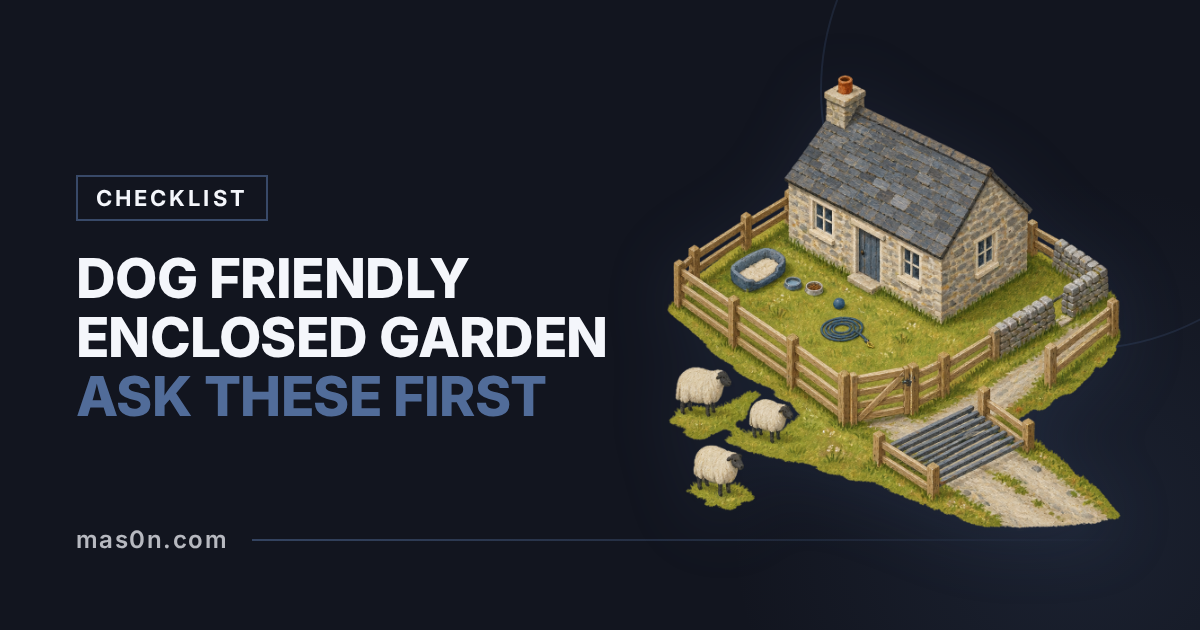
Almost every disappointing dog holiday I have heard about starts in the same place: a garden photo. Lawn, bench, a bit of fence, dog sitting obediently in the middle of it. What the photo does not show is the stile in the wall, the open driveway behind the camera or the gate that swings shut but never latches. If you are booking a dog friendly cottage with enclosed garden, the listing tick-box is the start of the conversation, not the answer to it.
This piece is the message you send the owner before you pay anything, plus how to read the reply.
Why “enclosed garden”means almost nothing on a listing
There is no standard behind the phrase. On every major agency site, that filter is applied because an owner ticked a box in their own property form. No minimum fence height. No gate specification. No requirement that the boundary is continuous, or that it is even a boundary rather than a hedge with a dog-shaped hole in the bottom of it.
So the same two words cover a 1.8m close-boarded fence with a sprung gate, and a cottage where three sides are walled and the fourth is the lane.
The gaps I see most often, in rough order of frequency: an open driveway or parking area that the garden runs straight into; stock fencing, which is built to keep sheep in a field and does nothing about a terrier; drystone walls with a squeeze stile or a tumbled section; and a beck or ditch along one edge, which looks like a boundary on a photo and is a dog-sized gap underneath the wall where the water goes through.
Garden photos also tend to be taken from the one spot that frames the view and crops the break. That is not usually dishonesty. Owners photograph what looks nice. You are the only person in this transaction thinking about the lowest fence panel.
A genuinely secure garden has three things: a continuous boundary with no gap wider than your dog’s shoulders, a gate that closes and latches on its own, and no reason for anyone else to walk through it.
What to ask before you book a dog friendly cottage with enclosed garden
Treat it the way you would any family holiday filter. Four lines decide it: boundary height, gate behaviour, dog cap and last-mile access. Write the questions once, paste the same text to every shortlisted owner, then put the answers side by side. The comparison is more useful than any single reply.
Boundary questions
- What is the boundary made of on each side, and how tall is it at its lowest point, not its average?
- Is any of it hedging, post-and-wire, stock fencing or drystone wall rather than solid fence?
- Are there stiles, squeeze gaps, field gates, becks or ditches anywhere on the perimeter?
- Has a dog ever got out of the garden, and where from?
That last one sounds blunt. Ask it anyway. Owners who know their garden answer it straight away and tell you which corner they fixed.
Gate questions
For most dogs this matters more than fence height. The classic escape is not a jump. It is a gate propped open by a bin collection, a delivery driver, a window cleaner or another guest cutting through to the shared parking.
- Does the gate self-close and latch without being pushed?
- Which way does it swing, and does it lead to a road, a drive or a field?
- Does anyone other than us have a reason to pass through the boundary during the stay?
Access questions
Ask where the parking, the bin store, the oil tank and the washing line sit. If the bins are outside the gate, you will be opening that gate several times a day with a dog in the house. If a public footpath crosses the plot, walkers will open it for you.
Dog-specific questions
Can the dog be loose in the garden unsupervised, or does the owner expect them on a lead? Is there a cattle grid at the end of the drive, and is the lane open? Is there livestock in the adjoining field, and at what times of year? A garden that backs onto sheep is a different proposition in March than in September.
How to check the answers without taking their word for it
Do the mapping before you ask anything. Satellite view in Google Maps or Bing Maps will show you the shape of the plot, the field gate, the track, and whether the “enclosed”side is a wall or a hedge line. Street-level imagery, where it exists, tells you the lane width and whether there is a pavement. Ordnance Survey mapping shows the rights of way: a dashed footpath running through the garden is worth knowing about before you send a deposit.
Then ask for two photos. Just two, and be specific, because a vague request gets you another picture of the bench:
- The gate, closed, photographed from inside the garden.
- The lowest or most gap-prone section of boundary, with a wheelie bin or a fence post in frame for scale.
Those two images settle most doubts in about thirty seconds of looking.
Reviews are the other check, and you read them for phrasing rather than stars. “We kept him on a long line in the garden”means the garden is not secure. “The gate doesn’t quite shut”means it does not shut. “Sheep in the field behind, which the dogs found very exciting”is a five-star review describing a problem.
On replies: a short answer can be fine if it is specific. “Six foot larchlap all round, gate has a spring and a drop latch, bins are inside the gate”is a good answer and needs nothing else. A long, warm, detailed reply that never mentions a measurement is a decline. So is “it’s fully enclosed, your dog will be fine”when you asked three separate questions. Owners who have thought about dogs describe the garden without being prompted twice.
Dog fees, caps and house rules that change the price
Dog charges on UK holiday lets are usually per dog per stay rather than per night, and they typically run into tens of pounds rather than a few pounds. Check the figure on the specific booking page, because it is one of the easiest costs to miss at the point of comparison, and a second dog can add a meaningful chunk to a week without ever appearing in the headline nightly rate.
If you have three dogs, filter on the cap before you filter on price. Two is a very common ceiling. Some properties also restrict by size or breed, and a few quietly exclude anything that is not a lead-walked, housetrained adult.
The rule people skip is whether dogs may be left alone in the property at all. Many cottages say no, full stop. Some allow it if the dog is crated. That single clause decides whether you can eat out, visit anywhere that bars dogs, or do a fell day in bad weather, so get it in writing rather than assuming.
Worth confirming by email before arrival: upstairs access, whether dogs are allowed on furniture or beds, where a crate can go, what the downstairs flooring is, and whether there is an outside tap, hose or boot room. A week of wet dog and no drying space is miserable in a way that no amount of garden fixes.
Finally, separate the refundable damage deposit from the non-refundable cleaning fee, and ask what counts as damage. Mud on a stone floor is normal wear. Mud on a cream sofa is a deduction.
What Cumbria adds to the enclosed garden question
Sheep country changes the stakes. Under the Dogs (Protection of Livestock) Act 1953, allowing a dog to worry livestock on agricultural land is a criminal offence, and farmers in the fells take it extremely seriously. The Countryside Code asks you to keep dogs under effective control around livestock year-round. Lambing runs roughly February to May in Cumbria, which is exactly when a cheap off-season week looks most tempting. If you are weighing dates, our month-by-month view of when to visit the Lake District is worth reading alongside the lambing calendar.
The weak point in hill-country gardens is almost always the wall, not the fence. Drystone boundaries were built to contain sheep and cattle, and they contain stiles, squeeze gaps, through-stones and sections that have tumbled since the owner last walked the perimeter. Stock fencing has squares big enough for a spaniel. Becks run under walls. Gates on fell-side properties often open straight onto a bridleway or an open-access track.
Here is the honest trade-off: for most dogs, a walk-out location beats a big garden. A cottage where you can step out of the door onto a lakeshore path or a quiet lane with no stock in the first field will do more for your week than half an acre of lawn with a dubious wall. If you are still choosing between areas rather than individual properties, the broader checklist in our guide to dog friendly cottages in the Lake District covers the base types and which valleys suit which kind of dog.
Arriving without a car, with a dog in tow
Arriving by train changes the shortlist entirely. The Windermere branch from Oxenholme puts you in the south Lakes, and Penrith is the gateway for Keswick and Ullswater. Both work for a dog trip, but only if the cottage is genuinely walkable from the stop while you are carrying a crate, bedding, food and a long line.
Under the National Rail Conditions of Travel, dogs travel free on National Rail services, generally up to two per passenger, provided they do not take up a seat. Check the current National Rail guidance before you travel, as operator-specific rules apply. Buses are different: carriage of dogs is at the operator’s and driver’s discretion, so the last leg is the part that can fail. Our notes on the Penrith to Keswick bus cover timings and connections for that run.
Make the taxi call before you book advance fares, not after. Firms vary on carrying dogs, some will only take them in the boot of an estate, and a few drivers decline on the day. One phone call is cheaper than a non-refundable ticket and a two-mile walk.
Then ask the owner what is already there. Bowls, old towels, a stair gate, a drying rack and a spare lead are common in genuinely dog-focused cottages, and every item they provide is one less thing in your rucksack. If you want a sense of what a car-free week actually costs once transfers and fares are in, the four-day car-free plan and budget breaks it down, and there is a car-free dog friendly hotel list if self-catering starts to look like hard work.
The detail that catches people out: a perfect garden at the end of a mile of unlit single-track lane with no footpath. In December, with a dog and two bags, that mile is the whole trip.
What an enclosed garden will not fix
Be honest with yourself about the gaps. Height solves jumping. It does nothing about climbing, digging under a fence line on soft ground, or bolting through a gate the second it opens. If your dog does any of those at home, they will do it harder in week one of a strange garden with new smells on the other side of the wall.
A garden is not a walk. It makes early mornings and wet evenings much easier, which is genuinely worth paying for, but a working breed still needs the miles. Plan the walks first, then pick the garden to suit them.
Shared-access conversions bring the other honest downside: noise. Barn conversions and terraced cottages often share a courtyard, which means other guests’ dogs, doors slamming at 7am and your own dog reacting to all of it through a wall built in 1780. If your dog is reactive, ask specifically how many units share the site and whether the gardens are divided or communal.
Set expectations before you travel. Walk the boundary yourself on arrival, in daylight, with the dog on a lead, before anyone goes off-lead. Ten minutes then is better than an evening spent wedging garden furniture into a gap in a drystone wall. Do that, ask the four questions in advance, and a dog friendly cottage with enclosed garden stops being a gamble on a tick-box and becomes the thing it is supposed to be: somewhere you can open the back door at six in the morning and go back to bed.
Frequently Asked Questions
What counts as an enclosed garden in a holiday cottage listing?
Whatever the owner decided when they filled in the property form. There is no industry standard, no minimum fence height and no gate specification behind the filter. Some are fully fenced with a sprung gate, others are walled on three sides with an open driveway on the fourth, so you have to ask for the detail yourself.
How high should a fence be for a dog friendly cottage with enclosed garden?
It depends on the dog, but 1.8m (six foot) is the figure to aim for with an athletic medium or large breed, and 1.2m is often enough for a small, non-jumping dog. Ask for the lowest point rather than the average, because the useful height of a boundary is its weakest section. And check the ground too, since a determined digger does not care how tall the fence is.
Can I leave my dog alone in a holiday cottage?
Often not. Many owners prohibit it entirely, some allow it only if the dog is crated, and a few have no rule at all. Confirm the policy in writing before you book, because it determines whether you can eat out or visit anywhere that does not take dogs.
How much do holiday cottages charge per dog?
Most UK lets charge per dog per stay rather than per night, and the figure commonly runs into tens of pounds rather than single figures. Caps of two dogs are widespread. Check the exact charge and the cap on the booking page at the time you book, since both vary by property and change between seasons.
Are dogs allowed on trains and buses to the Lake District?
Dogs travel free on National Rail services under the Conditions of Travel, generally up to two per passenger, as long as they do not occupy a seat. Buses are at the operator’s discretion, which means the driver can decline, so check the operator’s policy for your last leg. Taxi firms also vary, so ring ahead rather than assuming.