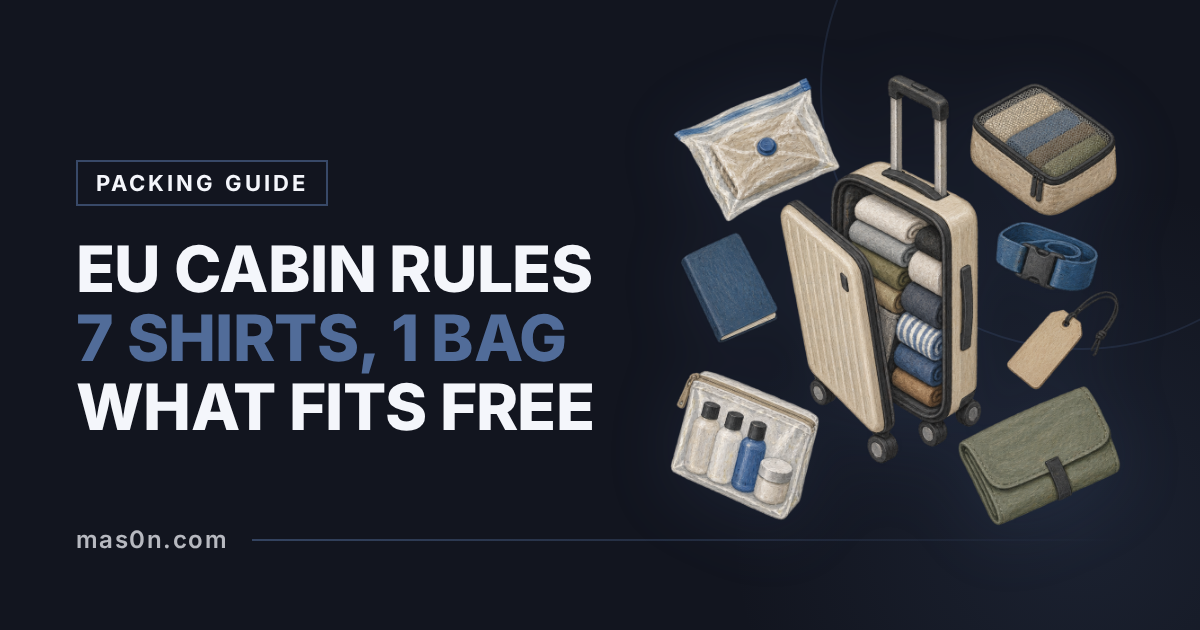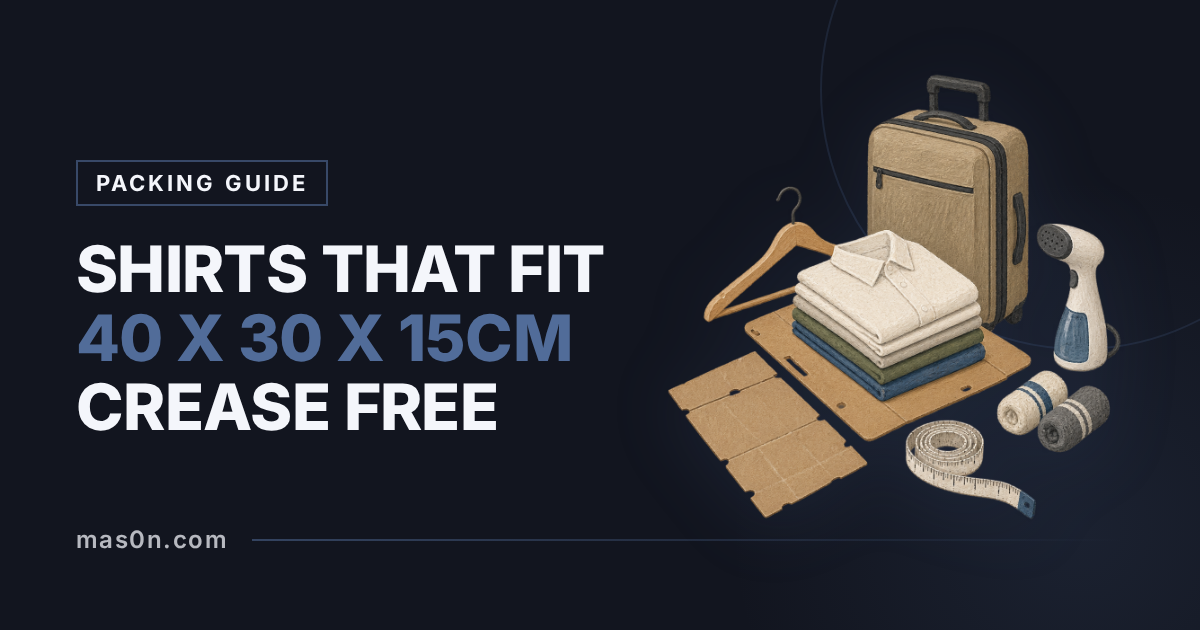
You can pack shirts in hand luggage under the 40 x 30 x 15cm rule and have them come out wearable. Two to four of them. Not a week’s worth, and not if you treat the bag like a small suitcase. The free under-seat item is a box with a fixed volume, and every shirt you add has to be bought with something else you leave at home.
Almost every guide to folding shirts assumes a 55 x 40 x 20cm trolley case with a lid that closes over a soft top layer. That bag now costs money on most low-cost carriers. The free one gets wedged under the seat in front, squashed by your own feet, and warmed by a cabin floor that sits above the air conditioning ducts. Different problem, different method.
What the 40 x 30 x 15cm allowance actually changes
Airlines for Europe, the trade body whose members include Ryanair, easyJet, Lufthansa and IAG, said in July 2025 that its member airlines would guarantee a free personal item of at least 40 x 30 x 15cm. That is a minimum, not a standard. Some carriers allow more, and dimensions still differ by airline, so check your own booking before you fold anything. If you fly mostly from UK airports, the broader picture of what travels free is covered in my notes on hand luggage rules on UK flights.
Do the arithmetic and 40 x 30 x 15cm is exactly 18 litres. A 55 x 40 x 20cm cabin trolley is 44 litres. So the free allowance gives you under half the working space you used to have, and that is before you lose any of it.
And you do lose it. Foam side panels, a padded laptop sleeve, curved zip lines and a base that is not perfectly flat all eat into the box. My working assumption is 13 to 15 usable litres once a 13 or 14 inch laptop is in the sleeve. Treat 18 litres as the outside of the envelope, never as the plan.
Gate sizers are the part people underestimate. They are rigid frames, and a bag that bulges at the lid fails even when it weighs almost nothing. Weight is rarely the binding constraint on a personal item. Shape is. A bag you have to kneel on to zip will not drop into the frame.
Honest limit: for most people this is a two to four shirt allowance. If you need five shirts and a suit, pay for the bigger bag and stop reading.
Why shirts crease, and why the fold is only part of it
Four things cause creases: pressure, movement, moisture and fabric. The fold only addresses the first one, which is why perfect folding so often disappoints.
Pressure alone makes a line. Pressure plus movement makes several, in random directions, because the fabric slides and buckles against itself every time the bag shifts. A loosely packed bag creases shirts worse than a tightly packed one, and that is the single most useful thing in this article. A merely adequate fold in a densely filled bag beats an immaculate fold with air around it. The fix is filling gaps, not folding harder.
Moisture is the one that does permanent damage. Cotton fibres are held in shape by hydrogen bonds that break when the fibre is wet and reform wherever the fibre happens to be sitting as it dries. Pack a shirt that is still faintly damp from a hotel laundry, or still warm from an airing cupboard, and you are setting a crease rather than making one. Under a seat, with your legs against the bag and the floor warm, it dries in exactly that shape. Let shirts cool and dry fully first. If in doubt, hang the shirt for an hour before it goes anywhere near the bag.
Fabric decides how much of this you can get away with. Pure cotton poplin creases hardest and recovers worst, which is a shame because it looks the best. Twill and Oxford cloth hold their shape better because the weave is heavier and less flat. A cotton-rich blend with two or three per cent elastane comes out of a compressed bag noticeably flatter than poplin, and usually needs steam rather than an iron. Non-iron and resin treated shirts survive this allowance well, though some people dislike the handle. For a two-night trip in a small bag, I would take the twill every time.
The fold that survives compression in a small bag
Button the shirt fully. Collar, cuffs, and the placket buttons you would normally leave open at the top. An unbuttoned placket twists under pressure and the twist shows across the chest, which is the one crease you cannot hide under a jacket.
Then fold face down on a flat surface, along the lines the shirt already has from the factory fold. Those creases are set. Fighting them puts a second set of lines next to the first, and no amount of steam fully removes both. If the shirt has been washed and hung since you bought it, make your own lines and reuse them on every trip.
Sleeves go back along the shoulder seam, flat, with the cuff tucked inside the body outline rather than hanging over the edge. Then the important bit: size the fold to the base of the bag, not to a shirt board. The usable base of a 40 x 30 x 15cm bag is around 38 x 28cm once you allow for seams and padding. Fold the shirt to roughly that footprint and you get one horizontal crease across the middle. Use a standard shirt-board fold and you end up with a narrower, taller parcel that needs two horizontal folds to fit. Shorter and wider wins.
Put a sheet of tissue paper or a dry-cleaning bag between each shirt. It sounds fussy and it is the highest-value thing you can do for almost no weight. The layers slide against each other under seat pressure instead of gripping and buckling. Plastic works better than tissue for this, tissue is quieter.
Protect the collar. A rolled pair of socks inside the collar stand, or a soft collar insert, stops it folding flat and creasing across the fold line where everyone can see it. Remove metal collar stays before packing and put them in a pocket. I have cut more than one shirt with a stay that pressed through under a laptop. For the longer-form version of all of this, including methods that suit bigger bags, see my guide to packing shirts without creasing.
Loading the bag: where the stack sits and what goes round the edges
Shirts go flat on top of everything else, closest to the lid. Never underneath a laptop, never underneath shoes, never on the bottom. The bottom of an under-seat bag takes the weight of everything above it plus whatever your heel does to it over two hours.
Build a level platform first. Rolled socks, underwear, a flat wash bag and a charger pouch go in the base and get pressed down until the surface is even. Any dip in that platform becomes a fold in the shirt above it. This is why the laptop sleeve is useful: it gives you one flat, rigid plane to build on.
Then fill the side gaps. A rolled T-shirt down each edge stops the stack sliding sideways when you shove the bag under the seat with your foot. Dense is good. A bag with no internal movement protects shirts better than any folding board.
Hard objects go in a side pocket or at the hinge end, away from the shirt layer. Chargers, a shaver, a phone brick, anything with a corner. And keep your liquids where you can pull them out in one movement, because security staff may still ask for them separately depending on the airport’s scanner; the CAA’s hand baggage guidance is the place to check the current position before you fly.
Last trick, and the cheapest one: wear the bulkiest item through the airport. A jacket, a jumper, the heavier of your two pairs of shoes. Every litre you wear is a litre you did not have to find.
Realistic plans for two to four days
A two-night London to Amsterdam trip is the honest sweet spot. One shirt worn on the outbound, two folded flat on top of the stack, and one lightweight merino or travel-knit shirt as the flexible layer that does not care what happens to it. One pair of shoes, worn. That fits, zips flat and drops into the sizer.
Stretch to three or four days and the maths only works with a laundry stop. A sink wash takes ten minutes. Drying is the problem. A merino knit shirt washed at 9pm and hung over a warm radiator or on a hanger in front of the room’s air conditioning is wearable by morning. Cotton poplin hung in a humid bathroom is not, and will be worse than the creased shirt you were trying to replace. Plan the wash around what will actually dry.
Rigid shirt cases are the question I get asked most. They work. A ShirtShuttle genuinely does keep a shirt flat and the collar square, and in a 55 x 40 x 20cm trolley I think it earns its place. In an 18 litre under-seat bag it is a fixed block taking a fixed slice of the only volume you have, and it does not compress. In practice it usually costs you a shirt rather than saving one. A soft packing folder with a thin board is the better compromise at this size. If you are working with the larger paid cabin bag, my write-up of fitting five shirts into one cabin case is the relevant one, and the week-of-shirts approach under EU hand luggage rules covers longer trips.
Be honest with yourself about the gaps. If the trip is four working days with client meetings, the free bag is the wrong tool. Pay for the larger cabin bag at the time of booking rather than at the gate, where the price is always considerably worse. Fees move constantly and vary by route and date, so check the figure on your own booking rather than trusting any number you read in an article.
Getting creases out at the other end
Hang the shirts the moment you are in the room. Not after a shower, not after dinner. The first twenty minutes out of the bag do most of the recovery work on their own, because the fabric is still warm and the fibres relax as they cool under their own weight. Unpack before you do anything else and you will often find you need nothing further.
If you do, run the shower hot with the bathroom door closed for ten to fifteen minutes, shirt on a proper hanger well clear of the spray. Then leave it hanging for another twenty minutes to dry in shape. Two minutes of steam does nothing except make the shirt damp and more creased. The waiting is the method.
Finish by hand. Wet your fingers, shake off the excess, and smooth along the seams first, then the body, then the placket. Cuffs and collar last, because they are stiffer and need the most pressure. Pull the fabric gently along the grain rather than rubbing across it.
Kit that actually helps: a travel steamer under 500g and a small spray bottle. Both fit in a side pocket. The in-room iron is the thing I would skip. Hotel iron plates pick up starch and adhesive residue from whatever the last guest pressed, and a dirty plate on a white shirt at 7am is a worse problem than a crease. If you must use one, test it on a towel first.
Some things will not come back. A deep crease set into dry cotton poplin under a laptop, across the chest, is there until the shirt is washed. Plan around that rather than hoping. Keep poplin for the shirt you wear on the plane, pack the twill, and the whole thing becomes much less stressful.
Frequently Asked Questions
How many shirts can you fit in a 40 x 30 x 15cm cabin bag?
Two to four, depending on what else is in the bag. The box is 18 litres on paper and realistically 13 to 15 usable litres once a laptop sleeve and padding are accounted for. Three folded shirts plus one worn is a comfortable plan for two nights. Four packed shirts means leaving out the laptop or the spare shoes.
Does rolling or folding keep shirts smoother in hand luggage?
Folding, for shirts with collars and plackets. Rolling suits T-shirts, knitwear and underwear, and those rolls are useful for filling the gaps around a folded shirt stack. A rolled formal shirt arrives with soft creases running in every direction, which steam struggles with more than one clean horizontal line.
Which shirt fabrics survive a small cabin bag best?
Twill, Oxford cloth, cotton-rich blends with a small percentage of elastane, and merino or travel-knit shirts. Pure cotton poplin creases hardest and recovers worst under compression. Resin treated non-iron shirts also do well if you get on with how they feel.
Should shirts go at the top or the bottom of the bag?
Top, flat, directly under the lid, on a level platform of soft items. The base of an under-seat bag carries the weight of everything above it and takes the knocks from your feet. Anything hard goes in a side pocket or at the hinge end.
How do you get creases out of a shirt in a hotel room without an iron?
Hang the shirt immediately, then close the bathroom, run the shower hot for ten to fifteen minutes with the shirt clear of the spray, and leave it hanging another twenty minutes to dry in shape. Smooth the seams, placket, cuffs and collar with slightly damp hands. A travel steamer under 500g does the same job faster if you fly often.