The Penrith to Keswick bus is the single most useful connection in a car-free Lake District trip, and it works better than most guides admit. You step off the West Coast Main Line, walk a few minutes, and about 45 minutes later you are standing in Keswick with the fells in front of you. No hire car, no all-day car park charges that can run into double figures, no hunting for a space in Lake Road at 10am on a Saturday.
What the operator pages do not tell you is how the bus fits around a train. That is where people come unstuck: a cheap advance fare to Penrith, a ten minute connection, and a delay at Warrington. So this is the journey from the platform outwards, with the fares, the timings and the honest fallbacks.
Which bus goes from Penrith to Keswick, and how long it takes
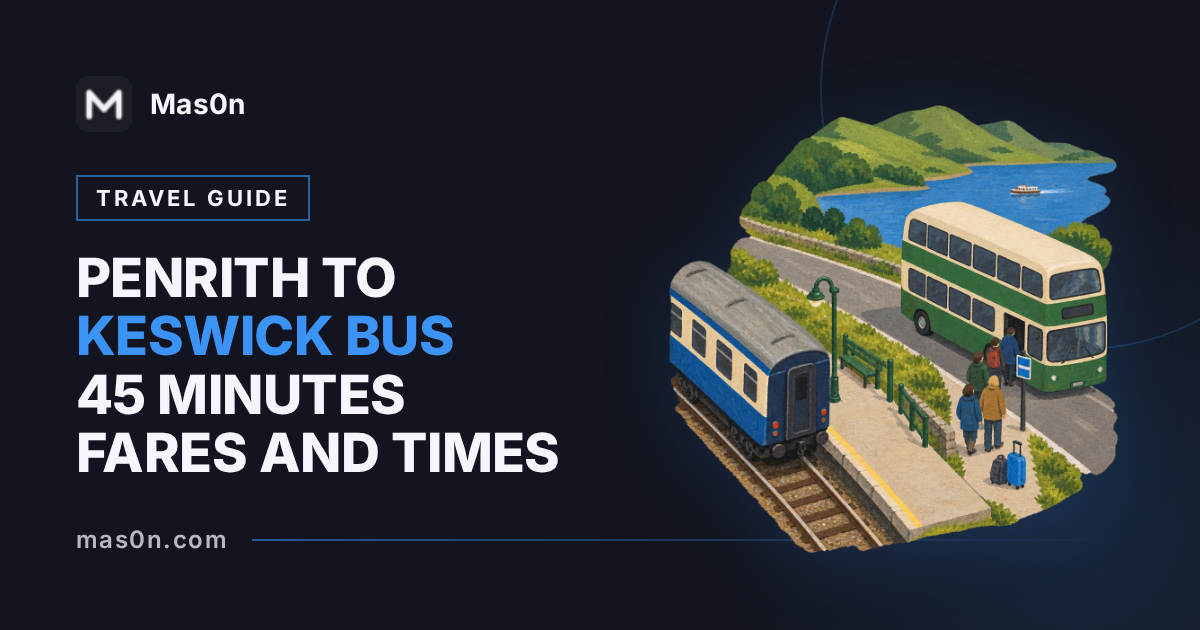
Two Stagecoach services do the work: the X4 and the X5. For your purposes they are the same bus. Both run Penrith to Keswick along the A66; the X5 then carries on west towards Cockermouth and Workington, while the X4 pattern is shorter. If you are going to Keswick, take whichever comes first.
Journey time is around 45 minutes. That holds up well most of the year, because the A66 is a fast road and there are only a handful of stops (Rheged, Troutbeck, Threlkeld). On a peak summer Saturday, or when there are roadworks on the dual carriageway section, add 10 or 15 minutes and do not plan a tight onward connection at the Keswick end.
Frequency is roughly hourly through the day. Sundays and evenings thin out sharply, and that is the detail that catches people. A Saturday train landing at Penrith after 8pm, or a Sunday morning departure planned by guesswork, is how you end up in a taxi. Check the current timetable on Traveline or the Stagecoach site in the week before you travel, not a PDF you saved in March. Timetables here change with the seasons.
Penrith bus station or the railway station stop?
There is a stop right by Penrith railway station, and most X4 and X5 journeys call there. The main interchange is Penrith bus station on Sandgate, a short walk into town. My rule: plan to board at the railway station stop, but check the stop list for your specific departure before you rely on it, and know where Sandgate is as a backup. If the bus you want starts from the bus station, boarding there also means you get a seat and a luggage space before the bus fills.
From the train platform to the bus stop at Penrith
Penrith North Lakes is a small station, which is good news. One exit, a short ramp, and you are on the road outside. Walking from the platform to the bus stop takes about three minutes if you are travelling light.
Be honest with yourself about the gaps. With two children, two big cases and a scooter, three minutes becomes ten, and that is before someone needs the toilet. If you are heading for the bus station on Sandgate instead, allow 10 to 15 minutes at family pace, uphill in places.
How much connection slack to leave
Ten minutes is tight. Twenty-five to thirty minutes is comfortable, and on a long-distance train it is the only sensible plan.
Here is the worked example. A Euston service arriving at Penrith at 14:21 with a 14:50 bus looks perfect on paper, and it is fine if you have a rucksack each and the train runs to time. Add cases and a family and it is a jog. Miss it and the next departure is an hour away, which turns a smooth arrival into a long wait with tired kids. A train landing at, say, 14:21 against a 15:50 bus wastes 90 minutes. The sweet spot is a train that gets you to the stop 20 to 30 minutes before a departure, and I will pay a few pounds more on the rail fare to get that.
If your Avanti or TransPennine train runs late and you miss the bus, nothing bad happens except waiting. Rail delay compensation covers your train ticket, not a bus connection you paid for separately, and bus tickets are not time-specific, so your single or day ticket is still good on the next one. Penrith town centre is five minutes away for a coffee and a sit down, which is a better use of an hour than the stop itself. A taxi from the station rank is the last resort and worth it only if the next bus is hours off or gone for the night.
Fares: singles, day tickets and what a week actually costs
The bus is cheap compared with the train. A single on the Penrith to Keswick leg costs only a few pounds; check the current fare in the Stagecoach app before you travel, because fares change. You cannot book it in advance and you do not need to. You turn up, and you tap or show a ticket.
Three ways to pay, in order of preference:
- Contactless on the reader as you board. Simplest option, and daily capping usually applies, so heavy users are protected.
- App tickets, bought in advance. The trap is the activation window: a ticket starts running when you activate it, not when you buy it. Activating on the train to pass the time burns part of the validity. Buy early, activate as you step on.
- Cash, which still works but do not count on getting change for a large note from a driver in Threlkeld.
When a day or multi-day ticket beats singles
Work out the week’s pattern before you buy the first single. A Keswick-based walking week rarely means one bus journey; it means Penrith in, Penrith out, a day up Borrowdale on the 78, a seasonal run over Honister to Buttermere, and possibly a trip to Cockermouth when the weather closes in.
Count the legs. Two singles in a day and a Cumbria-wide day ticket are usually close to level; three legs and the day ticket wins. Over five days of walking from a Keswick base, a multi-day Cumbria ticket has been the better buy almost every time I have done the sums, because the Borrowdale and Buttermere buses are included and you stop thinking about the cost of each hop. That matters more than the money: once the travel is paid for, you catch the bus up the valley rather than talking yourself out of it. The Derwentwater launch is a separate operator and is not covered, so budget that on its own.
Concessionary passes work here. An English National Concessionary pass gives free off-peak travel on these services, generally from 09:30 on weekdays and all day at weekends and bank holidays. Scottish and Welsh passes are not valid in England, which surprises visitors coming down from Glasgow by train. Child fares are discounted, and the age rules are worth reading properly if you are travelling with several children; I have gone through them in detail in my piece on free and reduced bus travel for kids.
Booking the train and the bus together without overpaying
The real money is on the rail leg, not the bus. Advance fares to Penrith bought weeks ahead can be a fraction of the walk-up price, and that is where you should spend your planning effort. Railcards stack on top. Split ticketing on the West Coast Main Line sometimes helps, particularly if you break at Preston or Lancaster, though it ties you to specific trains for each leg and adds a layer of risk you may not want on the way to a holiday.
Which brings me to the main mistake. A cheap advance ticket plus a ten minute bus connection is a false economy. The advance ticket is only valid on its booked train, so if things go wrong you are at the mercy of the operator’s delay rules, and you have also lost your bus. Pick the train that lands with slack, even if it is not the cheapest departure of the day. The money you saved does not buy back an hour on a kerb in the rain.
There is no through ticket covering the Keswick bus leg, so put it in your budget as a separate line. For how the whole lot adds up across a trip, including accommodation and food, see my four-day car-free Lake District plan with real costs.
Luggage, dogs, buggies and busy summer departures
Luggage is the quiet constraint. These are ordinary service buses, not airport transfers. A double-deck X4 or X5 has a small luggage area and a few spaces by the stairs, and in August it is already half full of other people’s bags when it reaches you. Large hard cases are awkward, and hauling one up to the top deck is not realistic.
Pack light and the journey changes character completely. One soft bag each that you can keep at your feet, and you board without thinking about it. That is a genuine argument for a packing discipline on this sort of trip, and the reason I bother with a fold that survives a squashed bag rather than taking a bigger case.
Dogs are generally accepted at the driver’s discretion, usually without charge, which makes a dog-friendly Keswick trip entirely doable by bus. In practice: short lead, dog in the footwell, avoid the busiest summer departures if your dog is nervous, and have a plan if the bus is standing room only. Policies do vary and drivers have the final say, so do not plan a trip that only works if the dog gets on. If you are building a trip around this, my round-up of dog-friendly car-free bases in the Lake District covers which towns work best for it.
Buggies: fold-and-stow is the safe assumption, and a compact fold is much easier than a travel system. Walking poles should be strapped to a pack, not carried loose. Bikes are not carried on these services, so if you want wheels, hire in Keswick.
Peak Saturdays and bank holidays are the pinch point, especially on the return leg. Keswick bus station in late afternoon can see a full bus leave with people still waiting, and if you are connecting onto a booked advance train at Penrith, that is a problem you created by cutting it fine. Take the departure before the one you need. Two buses before, if you have an advance ticket you cannot change.
Onward from Keswick, and when Windermere makes more sense
Keswick is a proper hub, which is why it rewards arriving without a car. From the bus station you can reach Borrowdale and Seatoller on the 78, Buttermere over Honister on the seasonal Rambler services, Cockermouth and the west coast on the X4 and X5, and the Derwentwater launch is a short walk down to the lakeshore for a boat-and-walk day that needs no vehicle at all. I have written up the wider network, including Ullswater and the Penrith end, in my guide to the car-free northern Lake District and the Penrith routes.
Southbound, the 555 links Keswick with Grasmere, Ambleside, Windermere and Kendal. It is a fine ride and a useful one. It is also slow: expect well over an hour to Windermere, and more in traffic through Ambleside on a summer afternoon.
Which settles a question people get wrong. Windermere is not the gateway to Keswick. The Windermere branch line serves the southern lakes, and if your destination is Keswick, Derwentwater or Ullswater, Penrith is the correct railhead: a main-line station with a short A66 bus hop at the end. Changing at Oxenholme Lake District for Windermere and then taking the 555 north adds hours. Arrive via Windermere when you are actually staying in Ambleside, Grasmere or Bowness, and via Penrith when you are going north. If you only want a day out from Penrith itself, the Ullswater buses towards Pooley Bridge and Glenridding are the better use of the day, with the steamers at the far end.
When the last bus has gone
Be realistic about evenings. Once the final Keswick departure has gone from Penrith, your options are a taxi for the 17 or so miles along the A66, which costs several times the bus fare, or a night in Penrith. Taxi supply at Penrith station is thin late on, so phone ahead rather than hoping for a rank. If your train from the south is scheduled to land near the last bus, book a Penrith room deliberately and take the first bus in the morning. A planned extra night beats a stranded evening, and it is cheaper than a late taxi plus the bad mood. I have listed the other traps in nine car-free Lake District mistakes to avoid, and this one is near the top.
For wider context on travel across the national park, the Lake District National Park Authority’s travel pages are worth a look before you book.
Frequently Asked Questions
Which bus goes from Penrith to Keswick?
Stagecoach services X4 and X5 run between Penrith and Keswick along the A66. For the Penrith to Keswick leg they are interchangeable, so take whichever departs first. The X5 continues west towards Cockermouth and Workington.
How long does the Penrith to Keswick bus take?
Around 45 minutes in normal conditions. Peak summer traffic, events in Keswick and roadworks on the A66 can add 10 to 15 minutes, so leave slack at the Keswick end if you have something booked.
Do you need to book the Penrith to Keswick bus in advance?
No. It is a regular service bus with no reservations: you tap contactless, show an app ticket or pay the driver. Buying an app ticket beforehand is fine, but activate it as you board rather than on the train, because the validity starts when you activate.
Does the bus stop at Penrith railway station?
There is a stop by the station and most X4 and X5 journeys call there, which makes the train-to-bus change about a three minute walk. Penrith bus station on Sandgate is the main interchange, roughly 10 minutes away on foot with luggage. Check the stop list for your departure so you know which one to head for.
How much connection time should I leave between my train and the bus?
Twenty-five to thirty minutes after a long-distance train from Euston, Glasgow or Manchester. Ten minutes works only if you are travelling light and the train is on time, and with buses roughly hourly the penalty for missing one is a full hour. If you have bought a non-changeable advance rail ticket for the return, take the Keswick bus one departure earlier than you think you need.