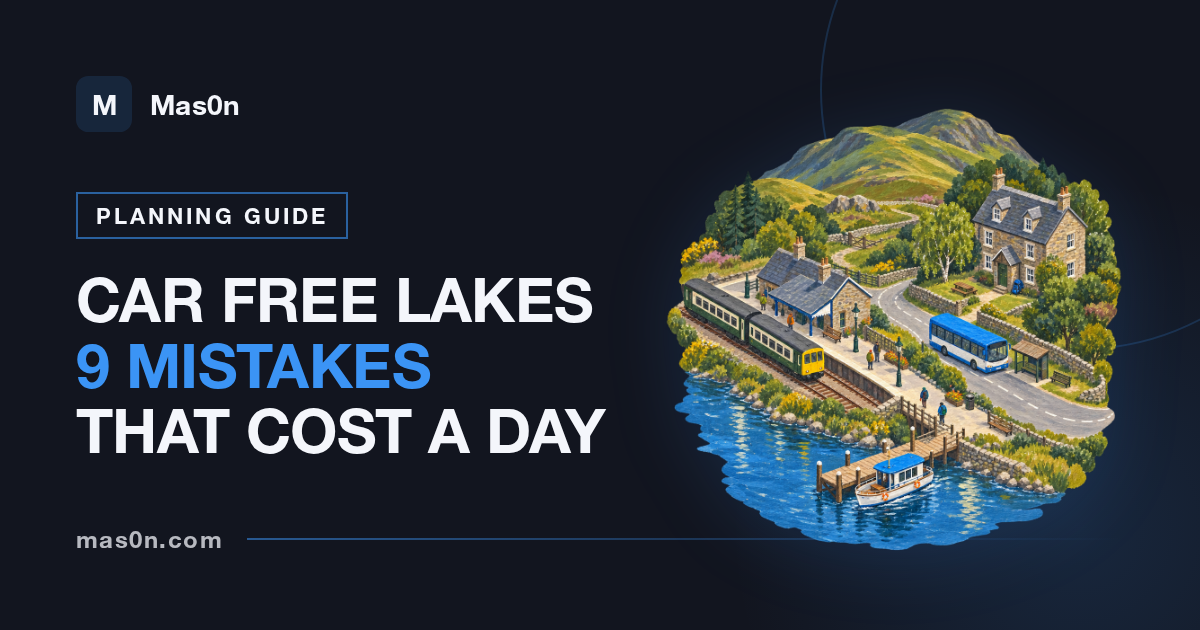
A car free Lake District holiday works, and it works better than most guides admit. But it works for one reason only: the connections happen to be good in a narrow band of the national park, and it falls apart the moment you plan as if the whole place is served like the corridor between Windermere and Keswick. Almost every disappointing car-free trip I have heard about came down to the same handful of decisions made in the wrong order. So this is the honest version: nine mistakes, what each one costs you, and the fix.
If you want the cheerful overview first, I have already written a plain guide to getting around the Lakes by train, bus and boat. This piece assumes you are past that and about to spend money.
What a car-free Lake District trip actually feels like
Two corridors do the heavy lifting. The 555 route runs the spine from Kendal and Windermere through Ambleside and Grasmere to Keswick, and in summer the open-top 599 adds frequency between Bowness, Ambleside and Grasmere. On those roads you barely think about buses. Step off them, into Eskdale, Wasdale, Haweswater or the back of Kentmere, and service ranges from a few a day to nothing at all.
The mental shift is the whole game. You stop planning around a postcode and start planning around a timetable, and you accept two or three fixed points in the day: the bus out, the boat back, the last connection home. Everything between those points is yours.
Who it suits: walkers, couples, and anyone happy to base in one valley for the week. Who struggles: groups trying to tick off four lakes in a day, and families with a toddler, a travel cot and a week of kit. Be honest with yourself about the gaps before you book.
One thing I would push back on. The bus-and-boat network is not a consolation prize for people who cannot drive. A launch across Windermere, a walk over the ridge and a bus home beats a day of hunting for a parking space at Grasmere in August. There is no car park to pay for, and no queue to join, in this version of the holiday.
Mistake 1: treating the rail journey as one ticket bought on the day
The Lake District hangs off the West Coast Main Line at three points: Oxenholme (signed Oxenholme Lake District) for the Windermere branch, Penrith for Keswick and Ullswater, and Carlisle for the northern edge and the Cumbrian Coast line. Windermere itself is a short branch run from Oxenholme via Kendal and Staveley, and it is a small, sleepy line with a modest number of trains a day rather than a metro service.
Walking up to Euston on the morning of travel and buying a return to Windermere is the most expensive way to do this journey, by a wide margin. Anytime tickets are priced for business flexibility. Advance singles are quota-controlled: a limited number at each price, released in batches, typically around twelve weeks ahead according to National Rail’s own ticket guidance, and once the cheapest bucket sells the next one up appears. Same train, same seat, different price entirely, purely because of when you clicked.
So book the mainline leg as soon as your dates are fixed. Two further levers are worth pulling:
- Railcards. A Two Together or Family & Friends Railcard costs £30 a year according to the official Railcard site at the time of writing, and gives a third off adult fares. On a single London to Cumbria return for two people, that often pays for itself in one go. Check current prices and eligibility on the railcard site before you count on it.
- Split points. Buying separate tickets for the same journey is permitted as long as the train calls at the split station. Preston and Lancaster are the obvious candidates heading north. It is fiddly, it is legal, and it sometimes saves a lot. I have written more on how UK rail tickets are actually priced and where the savings hide.
The trade-off nobody mentions: a through ticket protects you if the first train runs late, because you are entitled to travel on the next available service. Split or separately booked Advances tie you to named trains. Book the branch leg or a connecting bus with a tight ten-minute gap and a signalling fault at Crewe turns into a taxi from Oxenholme. Rule of thumb: leave one clear hour between mainline arrival and your last connection of the day.
Mistake 2: picking a base that looks central but is not connected
The map lies. A cottage at the head of a valley looks gloriously central and sits forty minutes from the nearest evening bus. Listings describe distance to the village, never distance to a served stop with a service after 6pm. “Ten minutes from the centre”can mean a mile of unlit, pavement-free lane, in rain, with a case.
So the question to ask the host is not “how far is it to the village”. Ask this instead: which stop do I use, how far is it from your door, and what time does the last bus call there? A host who cannot answer that has told you something useful.
Bases that carry a car-free week comfortably, judged purely on frequency, boat access and whether you can reach a walk without a car:
- Windermere and Bowness. The only base with its own railway station, plus launches from Bowness and the cross-lake ferry to Far Sawrey. Best for arriving late and for wet-day fallbacks. Busiest in summer.
- Ambleside. My pick for walkers. You sit on the 555 corridor, the Coniston bus and the Langdale service, with the pier at Waterhead five minutes from town. No station, so you arrive via Windermere.
- Keswick. Derwentwater launches, the Borrowdale bus, Catbells and Skiddaw within reach. No railway since the line closed in 1972, so Penrith is your gateway.
- Grasmere and Coniston. Quieter, well served on their single corridors, thinner in the evenings. Fine for a week if you are content with one valley.
Penrith is the underrated arrival point: mainline platform, then a connecting bus west to Keswick or south to Pooley Bridge and Glenridding for Ullswater. For the western valleys, the Cumbrian Coast line to Ravenglass gives you the narrow-gauge railway up Eskdale to Dalegarth, which is genuinely useful transport and not just a novelty. If you want the bases compared in more detail, including the trade-offs I have skipped here, see my longer piece on where to stay in the Lake District.
Mistakes 3 to 5: timetable errors that cost you a whole day
Mistake 3: arriving on a Sunday evening or in winter
Rural bus timetables thin out on Sundays and shrink again outside the summer season. A train that gets you into Penrith or Oxenholme at 8pm on a Sunday in November may arrive after the last onward bus has run. Your realistic options then are a taxi of several miles, pre-booked because you will not find one waiting, or a night near the station before moving on in the morning. Neither is a disaster. Both are avoidable by choosing an earlier train.
Before you book the outbound, do one check: find your intended last connection on the operator’s current timetable for your actual travel date, and note its departure time. Then pick a train that beats it by an hour.
Mistake 4: assuming summer frequency applies in shoulder season
Some of the best services are seasonal only. Open-top buses, the Honister and Ullswater leisure routes, and reduced winter sailings on the lakes all behave differently in October to how they behave in August. The core 555 spine runs year round; the pretty extras often do not. Check the season, not the route map.
Mistake 5: planning a linear ridge walk with no way back
This is where car-free itineraries break, and it breaks late in the day when you are tired. A linear route that quietly assumes someone will collect you at the far end needs one of three endings: a circular return to where you started, a finish at a pier where the launch still runs at that hour, or a village with a real scheduled service rather than a request stop on a summer-only route.
Good examples of the pier finish: walk from Bowness and return on a Windermere launch, or cross Derwentwater by boat and walk one leg back into Keswick. Build one buffer connection into every day rather than a chain of tight ones, and carry the last departure time written down, because mobile signal on the fells is unreliable.
Mistakes 6 to 9: the practical ones people only learn on arrival
Mistake 6: bringing the wrong luggage
A wheeled hard case is fine on a platform and miserable on a wet lane with a loose gravel surface. Twenty minutes from a bus stop to a guest house in Lakeland rain is where people learn this. Take a rucksack, one per person, carried not dragged.
The obvious objection is creasing, and it is a fair one if you are heading to a dinner or a wedding at the end of the week. Compression is not actually the enemy; loose packing is, because contents slide and refold themselves at random. Pack firmly and roll or interleave so nothing can move. I have gone through the options properly in my comparison of packing methods that keep shirts uncreased.
Mistake 7: paying for every leg separately
Single fares on two buses and a boat, three days running, add up faster than people expect. Stagecoach sells day and multi-day tickets covering the Cumbria network, and the lake operators sell rover-style tickets on their own boats. Buy the right pass on day one and stop doing mental arithmetic at every stop. Prices and product names change, so check the operator’s current range rather than trusting a figure from a blog, including this one.
Mistake 8: treating the boats as sightseeing rather than transport
The launches are the most useful thing in the toolkit. A crossing on Windermere or Derwentwater replaces a long road loop and lands you at a walking start the buses do not reach directly. The Windermere Ferry between Bowness and Far Sawrey takes foot passengers and bikes and saves a considerable detour to the western shore. All of it is weather and season dependent, so confirm sailings for your dates on the operator’s site and on the Lake District National Park Authority’s travel pages.
Mistake 9: having no wet weather plan
It rains. Without a car, a washout day with no plan means sitting in a guest house lounge until the rain stops, which in Borrowdale may be Thursday. The fix is small: pick two indoor options that sit on a route you are already using, so getting there costs nothing extra. From Windermere that might be a museum in town and a rail hop to Kendal. From Keswick, the town’s own attractions plus a bus ride you were going to take anyway. A washout should cost you an hour, not a day.
A booking order that prevents most of this
Sequence matters more than research volume. Do it in this order.
- Fix the arrival day and time. Work backwards from the last onward bus, not forwards from the cheapest train.
- Choose the base. Ask the host the stop-and-last-bus question before you pay a deposit.
- Book the rail Advance tickets. As early as your dates allow, with an hour of buffer at the interchange.
- Plan the walks last. Fit them to the timetable you now have, and give each one a return leg you have checked.
Then sanity-check the budget across four lines: mainline rail, local bus and boat passes, any narrow-gauge or ferry extras, and one taxi fare for the gap you have not spotted yet. Price each from current published fares. If you want a worked version with a real itinerary attached, I have set out a four-day car-free plan and how I budget it.
Finally, the honest exception. If your heart is set on Wasdale, Haweswater or a specific remote crag, hiring a car for one day of a week is a sensible answer, and a lot cheaper than a week’s hire. For a base in Ambleside or Keswick with walks reached by bus and boat, you will not need one at all, and you will spend the money on lunch instead.
Frequently Asked Questions
Is a car free Lake District trip realistic for a full week?
Yes, for the central corridors where most people want to be. A week based in Ambleside, Keswick, Windermere, Bowness, Grasmere or Coniston gives you enough walks, boats and towns to fill seven days without repeating yourself. A week spent chasing the remote western valleys by public transport is not realistic, and you should either shorten the ambition or hire a car for a day.
Which Lake District base works best without a car?
Ambleside for walkers, because it sits at the junction of the main bus corridor, the Coniston and Langdale routes and the Waterhead pier. Windermere or Bowness if you value having your own railway station, particularly for a late or Sunday arrival. Keswick for the northern fells and Derwentwater, reached by bus from Penrith.
How do I get from the West Coast Main Line to Keswick and Ullswater?
Penrith is the gateway for both. From the station, a connecting bus runs west to Keswick, and a separate route serves Pooley Bridge and Glenridding for Ullswater. Keswick lost its railway in 1972, so there is no rail alternative. Check the last departure for your travel date before booking the train, and have a taxi number saved in case the mainline service runs late.
Do the Windermere launches and open-top buses run all year?
No. The main Windermere and Derwentwater launches operate year round but on reduced winter timetables, while open-top buses and several leisure routes are summer-only. Confirm sailings and bus frequencies for your specific dates with the operators, because an itinerary that flows nicely in August can have two-hour gaps in it by late October.
What is the cheapest way to book train tickets to the Lake District?
Book Advance singles as early as you can, since they are released in limited quotas and the cheapest ones sell first. Add a railcard if two or more of you are travelling together, because a third off a long return usually covers the annual fee immediately. Then test a split at Preston or Lancaster, and weigh any saving against the loss of connection protection if your first train is delayed.