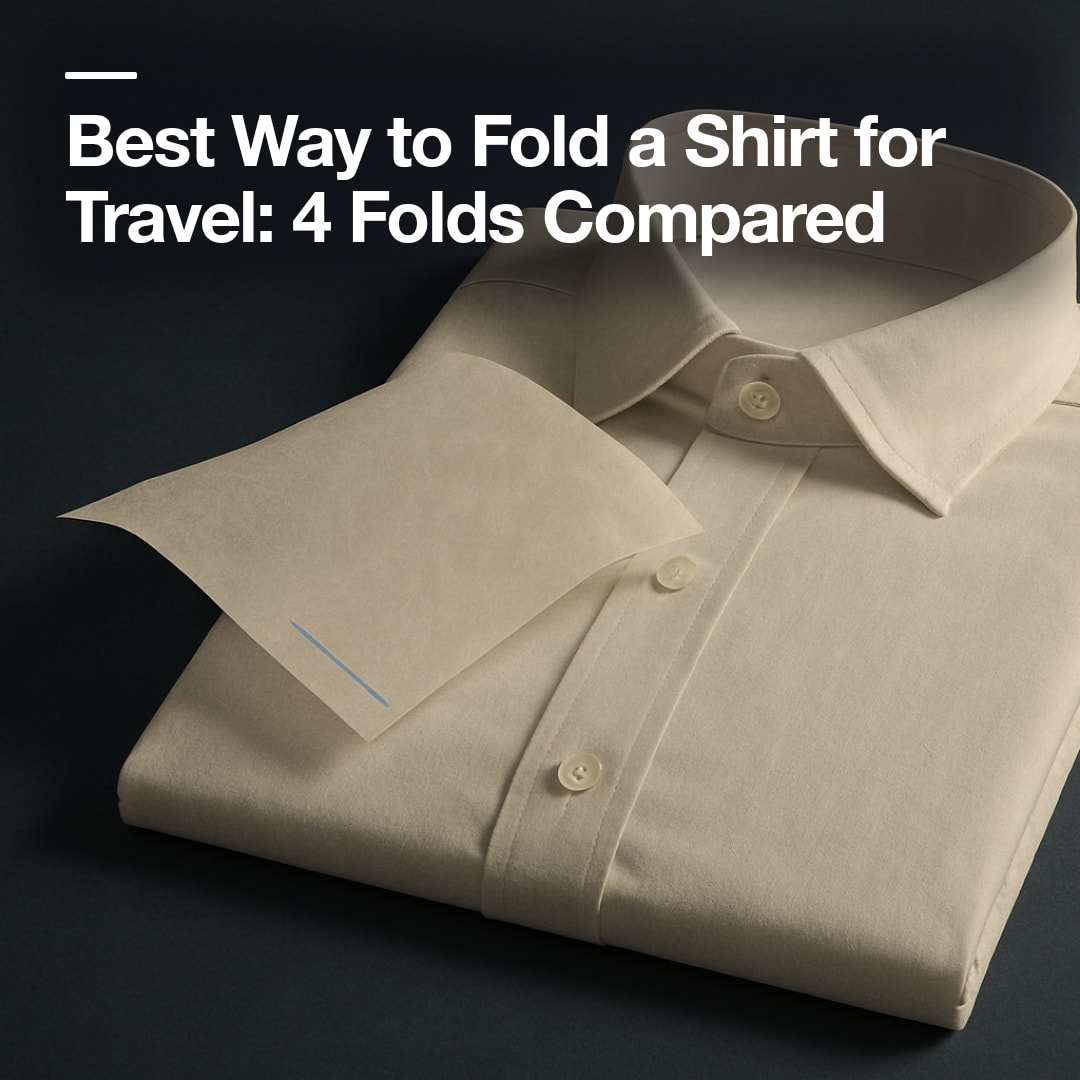
The shirt that lets you down is usually the one you folded most carefully. You spend four minutes getting the sleeves square on the hotel desk, slide it into a half-empty cabin case, and it comes out in Glasgow with a diagonal crease running from the second button to the hip. The best way to fold a shirt for travel is not one technique. It is a decision, made in about ten seconds, based on what the shirt is made of and what bag it is going into.
Four folds genuinely differ from each other. Everything else is a variation. Below is what each one does well, what it costs you, and, more usefully, what happens to the shirt after you have folded it, which is the part almost every video skips.
Why shirts crease in a case, and why the fold is only half the answer
Creasing has four causes, and only one of them is folding.
First, sustained pressure. A crease sets when fabric is held in one position under load, and the longer and heavier the load, the sharper the line. Second, movement. Contents that slide around get folded in random directions, over and over, every time the bag is lifted onto a rack or dropped by a handler. Third, moisture. Water lets cotton fibres reform in a new shape, which is exactly how an iron works and exactly why a slightly damp shirt sets its creases permanently in a warm case. Fourth, fabric memory. Cloth holds the shapes it has been pressed into before.
This surprises people: a mediocre fold in a tightly packed case beats a perfect fold in a loose one, every time. The perfect fold is not protecting anything if the stack is free to shift.
Fabric decides more than technique does
The same fold gives four different results on four different shirts.
- Non-iron cotton is resin treated so the fibres are chemically cross-linked. Hang it and it usually recovers within about an hour. It is the low-effort choice for a business trip packing list.
- Oxford cloth has a thicker, basket-weave surface that hides fold lines well. It creases, you just cannot see it from across a meeting room.
- Fine poplin, especially the fine two-fold cottons sold as 100s and 120s, is smooth and tightly woven, which means it shows every line. It needs help from a slip layer.
- Linen will crease. Always. There is no fold that prevents it, so treat linen as a bundle-wrap or garment-bag fabric and accept a lived-in look, or leave it at home.
Care labels are worth reading rather than guessing at, particularly on blends. The symbols are set internationally by GINETEX, and the ironing-temperature dots tell you roughly how much heat the fibre will tolerate before you start improvising with hotel kettles: one dot is the low setting, around 110C, for synthetics; two dots is around 150C for wool and most blends; three dots is around 200C, which is where cotton and linen live.
Be honest about the target here. A shirt out of a case will never look pressed. What you are aiming for is soft settling creases that drop out on a hanger in an hour, not sharp pressed-in lines that need an iron.
The prep that decides the outcome before you fold anything
Button it all the way up. Collar button, cuffs, every button on the placket. Most video guides fasten two or three and move on. That is where diagonal front creases come from: an unbuttoned placket twists inside the case and drags the front panel with it. Buttoning fully turns the shirt into a single flat panel that cannot rotate against itself.
Follow the factory creases. A new shirt arrives folded a particular way, and the fabric already holds that memory. Fold along those same lines and you are reusing creases that are already there. Invent your own and you are adding a second set on top of the first. Two sets of lines is what makes a shirt look slept in rather than folded.
Support the collar. Put a rolled sock inside the collar band, or keep the original card collar band from the packaging, or at minimum leave the collar stays in. A collapsed collar is the one crease you cannot steam out easily, because it sits on a stitched seam.
Fold on something hard. A desk, a table, a hotel luggage bench. Never a bed. A mattress dips under your hands and every fold line ends up slightly curved. An A4 sheet of paper or a thin piece of card, 21 by 29.7 cm, makes a decent template for the body width, and it stays in the shirt as light structure.
The four folds compared
1. The flat factory fold
Sleeves folded back along the shoulder seam, both sides folded in to roughly A4 width, about 21 cm, then one horizontal fold across the middle. That is it. Two vertical lines, one horizontal line, all of them where the manufacturer put them. The finished packet is about 21 by 30 cm and two or three centimetres deep, which is the shape a cabin case lid is built around.
Best for structured cotton, non-iron shirts and Oxford cloth going into a firmly packed hard case. Worst in a soft bag, where it slides and unfolds itself. It is the fold I use for maybe eight trips out of ten, and the reason is simple: fewest fold lines of any method, all of them pre-existing.
2. The tissue or dry-cleaning bag fold
Same fold as above, but with a slippery layer inside it and between shirts. Acid-free tissue paper, or the thin polythene bag your dry cleaning came back in, laid over the shirt before you fold the sides in and again between each shirt in the stack.
The mechanism is friction. Under pressure, cotton grips cotton and holds a bend. A slip layer lets the fabric slide a millimetre or two instead of locking, so the load spreads rather than concentrating on a line. It is the cheapest upgrade to any fold, it costs nothing, and it matters most on fine poplin and linen. If you take one thing from this article, take that one.
3. The ranger roll
Button the shirt, lay it face down, fold the sleeves back, then roll tightly from the collar down, keeping tension the whole way. Aim for a cylinder about the thickness of your forearm; a medium shirt rolls down to roughly 30 cm long, which is the length of the dead strip along the side of most holdalls. A tight roll behaves like a solid object. It cannot unfold itself and it fills gaps well.
Best for holdalls, rucksacks and any bag where the contents are free to move. Best for jersey, chambray, brushed cotton and anything with texture. It is the wrong choice for a crisp poplin shirt you plan to wear to a wedding, because rolling puts soft curved creases across the whole panel rather than a few straight ones. Curved creases are harder to steam out than straight ones, and they read as scruffy in a way that a single horizontal fold does not.
4. The bundle wrap
Lay your shirts flat and overlapping in a star pattern, four or five of them, put a core of soft clothing (knitwear, T-shirts, a rolled towel) roughly the size of a folded jumper in the centre, then wrap each shirt around the core in turn, largest and most delicate on the outside. Nothing gets a hard fold. Everything curves around a soft radius.
It genuinely produces the fewest creases of the four, and for linen it is the only folding method worth bothering with. The cost is access. To get one shirt out you unpack the entire bundle, and rebuilding it takes five to ten minutes, which is not something you will do twice in a hotel room at 11pm. Use it when you are unpacking properly at one destination, not on a three-city trip. The same logic applies to tailoring, which is why packing a suit works on a fold-and-layer approach rather than anything tightly rolled.
Which fold suits your bag?
The bag matters as much as the shirt, because the bag determines whether the stack stays still.
Hard or semi-rigid cabin case (around 55 x 40 x 20 cm on many airlines, though allowances change, so check yours before you fly). Flat fold, with a slip layer. Shirts go in last, flat across the top of everything else, positioned away from the hinge and away from the wheel housing. Those are the two places a case flexes most in transit, and flex means movement, and movement means creases. Stack position beats folding technique. I would rather have an average fold in the right place than a beautiful one sat over the wheels.
Soft holdall or rucksack. Roll, or bundle wrap. Flat folds have nothing to press against in a soft bag and simply shuffle apart. If you are travelling by rail with a holdall on an overhead rack, assume it will be shoved sideways at least twice, which is one more reason to lean towards rolls. Worth pricing your journey properly too, since rail fares vary a lot depending on how you buy.
A hard travel shirt case. Products like the ShirtShuttle solve the pressure problem at source: the shirt sits in a rigid shell and nothing presses on it at all. Having used one and written up how it performed, my honest verdict is that it works, and that the trade is volume. A rigid shell occupies a fixed block of your cabin allowance whether it holds one shirt or none. For an overnight trip with one shirt that matters, take it. For a week with five shirts, the space it costs is worth more than the creases it prevents.
Garment bag. Wins when you are driving, when the shirt is linen or a heavily structured jacket goes with it, and when there is somewhere to hang it at the other end. Loses on any trip involving a plane hold, a busy train, or a hotel that hands you a wardrobe with four wooden hangers on a fixed rail. Carrying a garment bag through an airport to protect one shirt is more trouble than the crease it prevents.
Packing order and density: the step most folding guides skip
Pack the case tightly. A firmly packed case immobilises its contents, and immobile contents crease in one predictable direction rather than twenty random ones. Fill dead space with socks, rolled underwear, a beanie, anything soft, until no gap is bigger than your fist. Gaps are the enemy, not weight.
The order I use in a standard cabin case, wheels down:
- Shoes and toiletries at the wheel end, in bags, soles facing out and socks stuffed inside the shoes, taking the impacts.
- Trousers and knitwear as a flat middle layer, filling the width completely, right into the corners.
- Two flat-folded shirts on top, with a dry-cleaning bag between them and another over the top one.
Never pack a shirt that is even slightly damp. Warmth plus moisture plus pressure is the exact recipe for a permanent set, and the worst offender is hotel laundry returned in the morning still faintly cool to the touch. If it is not properly dry, hang it over the bathroom rail while you shower and pack it last, or pack it inside a plastic bag away from everything else.
On quantity, I have stopped taking one shirt per day. A three-night UK business trip runs comfortably on two shirts and a merino base layer, the 150 to 200 gsm weight rather than anything heavier: wear one, hang the second on arrival, steam it in the bathroom on the second evening. Merino is the reason it works, because it does not hold odour the way cotton does. Three shirts in a cabin bag means three shirts creasing against each other. Two shirts with a slip layer between them arrive noticeably better. If you want the longer version of the packing side, I have written up seven shirt-packing methods and how each one held up.
How to get creases out of a shirt in a hotel room without an iron
Hang it the second you get through the door. Before the laptop, before the kettle, before you sit down. Most travel creases are soft and will drop out on their own if the shirt is given an hour on a hanger with air around it. Do not leave it flat on the bed while you answer emails.
If it needs more, use the bathroom. Hang the shirt on the outside of the shower rail or from the door hook, clear of the spray, run the hot tap or shower for 10 to 15 minutes with the door shut, then turn it off and leave the shirt in the steam for a few more minutes. Take it out and hang it on the outside of the wardrobe for another 20 minutes to dry fully before you put it on. Wearing it damp will just set new creases in the shape of your shoulders.
The damp towel trick works on stubborn spots: wring a hand towel almost dry, lay the shirt flat on a hard surface, press the towel over the crease and smooth it with your palm for 20 or 30 seconds. A travel kettle held about 15 to 20 cm from, not touching, a hanging shirt gives you a rough steamer for a collar or a cuff. Watch the plastic housing and keep the steam moving. None of this will save linen. Linen needs actual heat and pressure, so steam it, accept the softened look, or press it.
And sometimes you should just pay. If the shirt has hard fold lines across the front and you have a 9am meeting, ask at check-in about the press service, what the cut-off is for same-day return, and what it costs. Many hotels want items before mid-morning for same-evening return, but it varies, so ask rather than assume. A pressed shirt is usually the cheapest line on the bill and it removes the problem entirely.
Frequently Asked Questions
What is the best way to fold a shirt for travel in hand luggage?
Button the shirt fully, support the collar, fold the sleeves back along the shoulder seams, fold the sides in to about A4 width, roughly 21 cm, along the original factory creases, then make one horizontal fold. Lay a dry-cleaning bag or tissue over it first. Place it flat on top of the packed case, away from the hinge and the wheels.
Is rolling or folding better for shirts in a suitcase?
Folding, in a hard case that is packed tightly. Rolling, in a soft holdall or rucksack where a flat stack would slide apart. Rolling saves more space and holds together better, but it puts curved creases across the whole shirt, which look worse on crisp poplin than a single straight fold line does.
Should you use tissue paper or a dry-cleaning bag when packing shirts?
Yes, and it is the highest-value thing on this list for the money, which is nothing. The slippery layer lets fabric slide under pressure instead of gripping and holding a bend. Use it between every shirt in the stack, and over the top one. It makes the biggest difference on fine poplin and linen, less on Oxford cloth.
How many shirts can you pack in a cabin case without creasing them?
Two flat-folded shirts on top of a typical 55 x 40 x 20 cm cabin case, with slip layers between them, arrive in good shape. Three is workable. Beyond that the stack gets thick enough that the lower shirts take real pressure, and you are better off planning to wear one and steam another mid-trip than carrying one per day.
How do you get creases out of a shirt in a hotel room without an iron?
Hang it immediately on arrival and give it an hour. If creases remain, hang it in the bathroom clear of the spray, run the hot shower for 10 to 15 minutes with the door closed, then hang it outside the wardrobe for 20 minutes to dry. A damp towel pressed over a stubborn crease helps. Linen will need a proper press.
Pick the fold to suit the fabric and the bag, then spend your attention on density and stack position, because that is where the result is actually won. The best way to fold a shirt for travel takes about thirty seconds once you have decided which of the four you are using. Everything after the fold is what people get wrong.